4 Jun 2026
Towards a Significant Reform of Foreign Direct Investment Screening in Finland: Draft Government Proposal on New FDI Act Published
Related practises

A draft Government proposal for new foreign direct investment (FDI) legislation in Finland was published on 3 June 2026, paving the way for broadened screening of foreign investments. The proposal is driven by a materially changed geopolitical landscape and technological developments, as well as the ongoing revision of the EU Regulation on the Screening of Foreign Direct Investments. In this article, we take a closer look at the proposed changes.
The current FDI screening regime dates from 2012. It establishes a framework for screening and, where key national interests so require, restricting the transfer of influence to investors subject to foreign influence in acquisitions related to the defence or dual-use sectors, business with security authorities or other entities critical to society.
On 3 June 2026, the Ministry of Economic Affairs and Employment published a draft proposal for the new Act on the Screening of Foreign Investments and Approval Procedures.
The key proposed changes include:
- broadening the definition of a foreign investor;
- extending mandatory screening to new sectors and greenfield investments;
- removing the voluntary filing mechanism;
- introducing new screening thresholds;
- establishing a two-step review process with the National Emergency Supply Agency as the first-stage authority; and
- replacing criminal fines with administrative penalty payments.
Broader scope of investors subject to mandatory approval requirements
Under the draft proposal, the new FDI Act would extend mandatory approval requirements to all investors domiciled outside Finland, including those within the EU and EFTA. This is a departure from the current regime, which treats only non-EU/EFTA investors as foreign with the exception of defence sector investments. For natural persons, foreign investor status would depend on nationality rather than place of residence.
For entities registered in Finland, the foreign investor status is triggered by a direct or indirect ownership of at least 10% of the voting rights or the exercise of corresponding actual influence by a non-Finnish owner.
Broader scope of target companies subject to mandatory screening
Under the current regime, approximately 30–40 FDI filings have been reviewed annually, as set out in the table below:
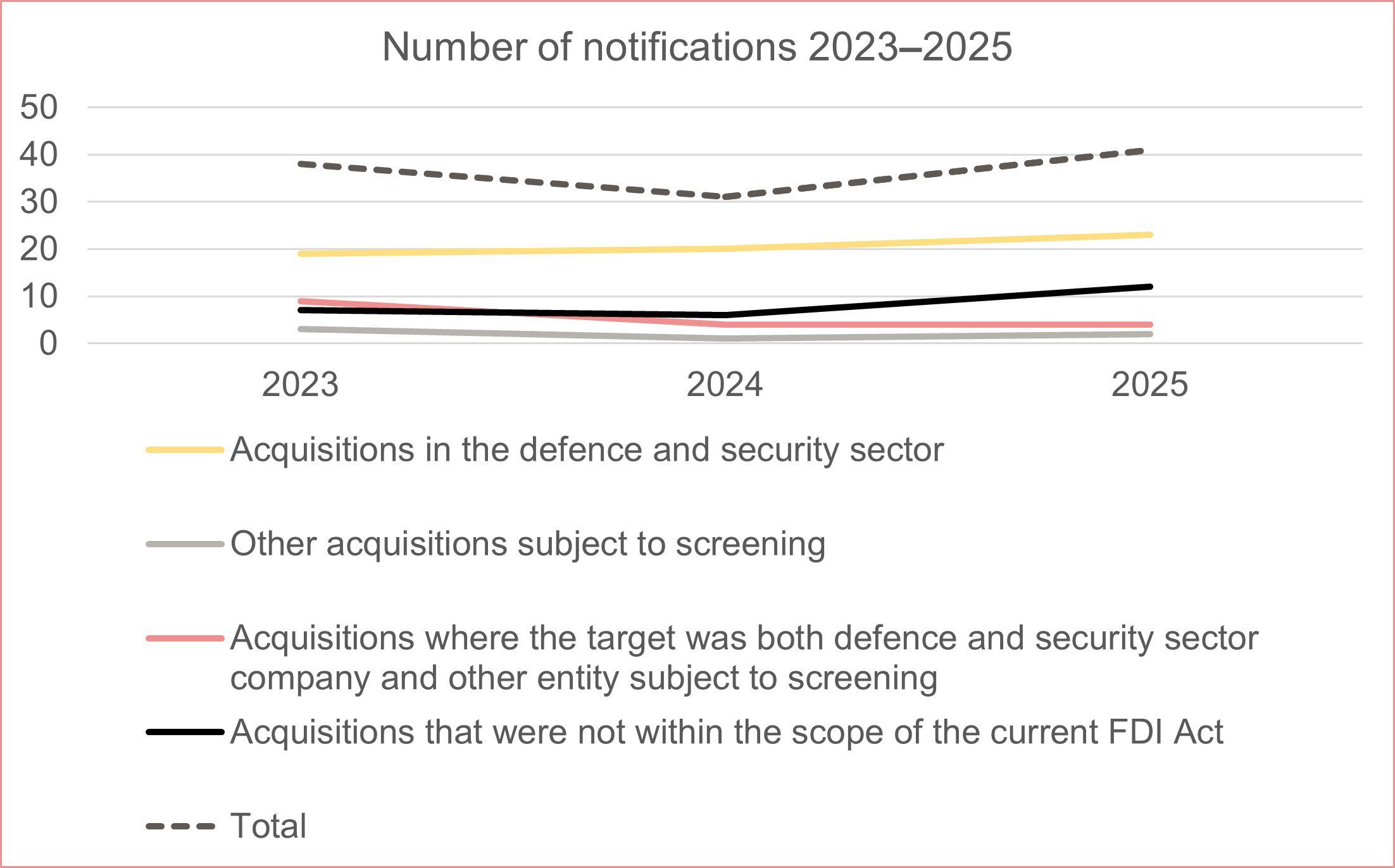
The draft proposal estimates that this number would increase by a further 65–90 filings.
Under the draft proposal, Finnish FDI screening would be extended to many target companies outside the defence and security sectors that are currently subject only to a voluntary filing or fall outside the screening mechanism altogether.
In line with the proposed EU FDI Regulation, which sets out minimum requirements for Member States' screening mechanisms, the draft proposal includes a mandatory prior authorisation requirement for foreign investments in Finnish targets that:
- develop, produce or commercialise dual-use and defence-related products;
- produce, research or develop semiconductors, quantum technologies or certain AI technologies;
- are active in transport, energy or digital infrastructure sectors and are considered critical to the vital functions of society and to national security;
- conduct exploration, extraction, processing, recycling, recovery or stockpiling activities in respect of strategic raw materials;
- are central to the financial system or payment systems, including central securities depositories as well as global providers of specialised financial messaging services, or constitute other systemically significant financial entities; or
- own, develop or maintain information systems specifically designed for electoral functions, such as voter registration databases, vote counting and results verification systems as well as other systems used for verifying electoral results.
Beyond the minimum scope set by the EU FDI Regulation, the draft proposal would extend mandatory screening to targets that intend to develop defence materiel or other products or services important for national military defence or the Finnish defence industry in the future. While companies active in the dual-use sector would remain within scope, the draft proposal clarifies that screening is not intended to apply to companies that use dual-use items only to a limited extent.
The target's access to information important for national security, comprehensive security or security of supply would also trigger mandatory screening. Additionally, targets that produce or supply ICT or information security products or services that are relevant to national security, comprehensive security or security of supply would fall within mandatory screening.
Further, targets whose operations, products or services relate to security of supply, critical infrastructure or other vital functions or services of society, a category previously subject only to voluntary screening, would be brought within the mandatory screening regime under the proposal. The mandatory prior approval procedure would apply to all targets within scope, thereby removing the voluntary filing mechanism altogether.
Additional ownership thresholds
Under the current FDI Act, mandatory and voluntary filings are triggered when a qualifying foreign owner acquires at least one-tenth, one-third, or one-half of voting rights or corresponding actual influence in a Finnish entity subject to screening. Under the draft proposal, prior approval would also be required before an investment is completed where ownership or corresponding actual influence exceeds 66.6% and 90%. All thresholds would apply to any subsequent acquisition of additional ownership. In addition, the screening authority could, for a particular reason, require an application for approval even where actual influence increases without any of the above thresholds being exceeded. Corresponding actual influence could be based on contractual voting arrangements, board member appointment rights, veto rights or means of exerting pressure.
Greenfield investments brought within scope
Currently, greenfield investments, meaning investments made to establish an entirely new business operation, fall outside the scope of the current FDI Act, but may be subject to approval requirements under certain sector-specific regulations.
Under the draft proposal, foreign ownership in certain greenfield investments would become subject to screening. Such screening would cover investments involving the establishment of a new company, business unit or entity for the purpose of carrying out the following types of economic activity in Finland:
- defence sector projects including production or supply of defence materiel or other important products or services;
- manufacturing or development of export-controlled dual-use items;
- certain port and airport infrastructure and services;
- logistics terminals in certain critical sectors;
- certain data centres;
- certain energy infrastructure projects, including renewable energy projects and battery energy storage systems, reaching 100 MW in capacity either in isolation or together with the investor's other projects; and
- mining, processing and storage related to EU strategic raw materials.
Changes to review process and conditions for approval
Under the current FDI Act, the Ministry of Economic Affairs and Employment acts as the screening authority, with limited procedural deadlines and no formal distinction between initial and in-depth reviews.
The draft proposal introduces a two-step review process: an initial review, generally by the Finnish National Emergency Supply Agency, within 45 days, followed, where necessary, by an in-depth review by the Ministry with no fixed deadline. Cases of significant impact could be referred to the plenary session of the Government.
As the current approval process typically takes approximately two to three months, the proposed 45-day initial review period is expected to shorten the overall timeline for the majority of cases that are resolved at the initial review stage without proceeding to an in-depth review.
The new Act would replace the current "key national interest" assessment standard with more detailed criteria, also taking into account the impact on the security of other EU Member States. Acquisitions could still be approved subject to conditions or denied. Finland has never prohibited a foreign acquisition under the FDI regime, but transactions have been approved subject to conditions. In some cases, applications have been withdrawn following preliminary discussions with the Ministry.
Stricter sanctions for failure to notify
Currently, failure to comply with the approval requirement may result in the imposition of criminal fines, though to our knowledge no such fines have been imposed to date. The draft proposal would replace criminal fines with administrative penalty payments, while significantly increasing the maximum level of sanctions.
The maximum administrative penalty would be the higher of EUR 10 million or 10% of the operator's worldwide turnover for the previous financial year. The maximum personal penalty would be EUR 500,000. The National Emergency Supply Agency could impose penalties of up to EUR 100,000, while larger penalties would be imposed by an independent penalty payment board. The shift from criminal fines to administrative penalties reflects the view that an administrative sanctions regime offers a more effective, flexible and proportionate enforcement tool for FDI supervision than criminal law measures, which are inherently a measure of last resort.
Timeline for the adoption of the proposed amendments
The Government proposal is intended to be submitted to Parliament no later than September 2026. The new FDI Act is planned to enter into force in spring 2027.
Investors should consider the impact of the proposed amendments on their planned transactions well in advance.
Additional information
Our Competition & Regulatory practice will continue to follow the progress of the draft Government proposal. If you have any questions or would like to discuss the topic further, please feel free to contact the lawyers listed on this page.


